Posts

Showing posts with the label CampaignForSustainability

Business Sustainability: A Key Driver Of Conscious Development | truCSR

Image
For many, particularly in the business world, sustainability is becoming increasingly important. Climate change continues to have an effect on our lives and the fate of all other animals on the planet. Sustainable business practices are becoming increasingly important for business owners, executives, and administrators. According to NASA, human activity is more than 95 percent likely to be causing global warming. Because of its dependence on land, resources, fossil fuels, and continuous production and consumption, human industry is a significant contributor to climate change.  The process of operating a business without adversely affecting the environment is known as business sustainability. A green company serves the local and global environment's best interests, which means it helps the society and economy that depend on a sustainable world. An environmentally conscious company considers more than just profits; it also considers its social and environmental effects. Such a compan...

Water at the Juncture of Sustainability and Development | Campaign for Sustainability

Image
Lessons from Cape Town, Beira and Lima Water is important element for socioeconomic growth, healthy habitats, and human survival itself, and it is at the heart of sustainable development. It is essential to the development and protection of a wide range of human benefits and services, reducing global disease burdens and improving population health, welfare, and productivity. Agriculture is by far the most water-intensive sector, accounting for 70% of all water withdrawals, this figure varies greatly between countries. Rainfed agriculture is the most common agricultural production method in the world, but its current productivity is only about half of what it could be with optimal agricultural management. Water demand is shared by industry and electricity, accounting for 20% of total demand. In comparison to less-developed countries, where agriculture dominates, more developed countries have a much higher proportion of freshwater withdrawals for industry. Industry faces a variety of cha...

Food Security in a Globalized World for Sustainable Development | Campaign for Sustainability

Image
  According to the UN Committee on World Food Security, food security means that all people have physical, social, and economic access to adequate, secure, and nutritious food that meets their food preferences and dietary needs for an active and balanced life at all times. As a result, the main dimensions of the household food security construct are physical availability of food, economic and physical access to food, and sufficient food utilisation, which is a feature of the body's capacity to absorb and use nutrients, as well as dietary quality and food safety. A changing climate, an increasing global population, rising food prices, and environmental stressors will all have substantial yet unpredictable effects on food security in the coming decades. Adaptation plans and policy responses to global change are urgently needed, including options for dealing with water allocation, land use trends, food trade, postharvest food production, food prices, and food protection.  Food se...

A Sustainable Vision Based in Climate and Environmental Literacy | Campaign for Sustainability | truCSR

Image
Written by Rebecca Shibu Compiled by Vrinda Panpalia Edited by Yamini Peter A climate-literate person understands the essential principle of the climate system on Earth, they know how to assess scientifically credible information with regards to climate, they communicate about climate and climate change in an effective way and they are able to make informed choices and responsible decisions keeping in mind its impact on the climate.  Climate change is an ideal interdisciplinary subject for lifelong learning about scientific processes and how humans influence and are influenced by the Earth's structures. This vast theme can be addressed on several levels, from comparing daily weather to long-term records to investigating abstract climate representations in computer models to analysing how climate change affects humans and the environment. Understanding all of these interconnected principles would necessitate a systems-thinking approach, which entails the ability to comprehend compl...

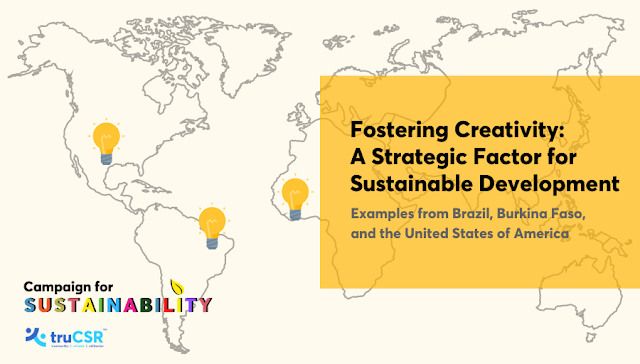
Fostering Creativity: A Strategic Factor for Sustainable Development | Campaign for Sustainability | truCSR

Image
Written by Rebecca Shibu Edited by Yamini Peter Creativity is a key engineer for facilitating social harmony, sustainable development, technological invention, and scientific advancement. It is manifested through human activities at different levels. However, according to a standard definition , ‘creativity’ is often perceived as the ability to produce something new/novel and appropriate. Today, there is unprecedented importance given to creativity due to the implementation of policy-based, innovation-oriented national development strategies and increasingly pressing global issues, such as global warming and terrorism. It becomes crucial to establish that culture underwrites the creativity and the creative process in places and its people. They contribute significantly to economic diversifications and job creation which goes on to improve the quality of life. It plays a predominant role in sewing the social fabric and sustaining the cultural diversity of a place and its people. Hence,...